Modern work no longer happens in one fixed place.
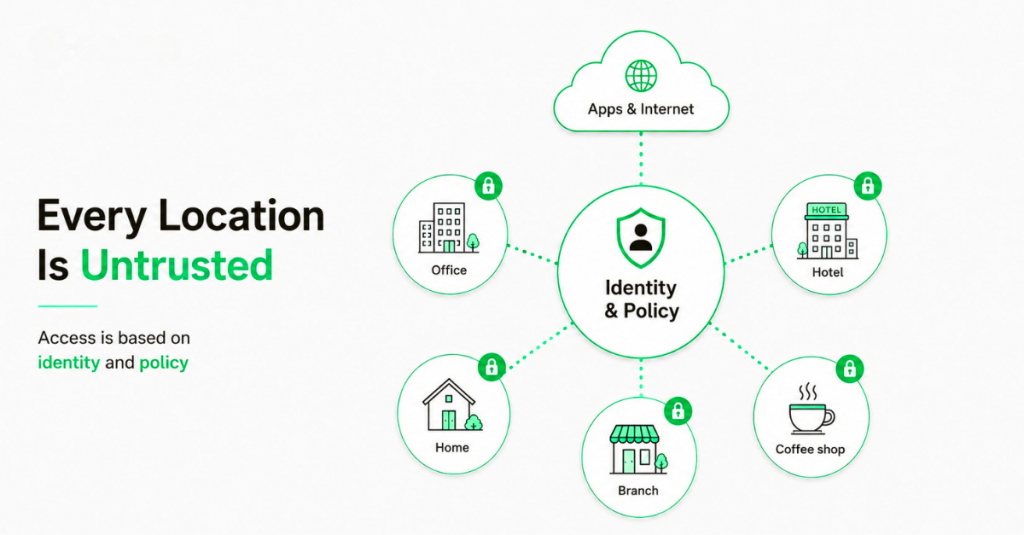
Employees connect from offices, homes, hotels, customer sites, branch locations, retail stores, and, of course, coffee shops. Applications are no longer held neatly inside the corporate data centre either. They now sit across SaaS platforms, public cloud, private environments, and the open Internet.
This creates a problem for traditional network architecture.
Many organisations are still relying on models designed around fixed offices, private lines, central data centres, and trusted corporate networks. That approach becomes harder to manage when users, devices, applications, and locations are constantly changing.
This is where coffee shop networking comes in.
Coffee shop networking is a modern approach to connectivity and security that takes inspiration from the simplicity of working from a coffee shop. A user connects to basic Internet access, opens their laptop, and reaches the applications they need. The network itself is not trusted, but access can still be secured through the right identity, device, and policy controls. Cloudflare describes coffee shop networking as a way to provide simpler connectivity and security for modern work-from-anywhere experiences.
Why traditional networks are under pressure
Traditional enterprise networks were often built around three ideas: castle-and-moat security, hub-and-spoke networking, and dedicated on-premises hardware.
The castle-and-moat model assumes there is a trusted internal network and an untrusted outside world. Once a user is inside the corporate network, they may receive broad access to resources. That approach becomes risky when the perimeter has dissolved and users need access from anywhere.
The hub-and-spoke model routes branch traffic back through a central data centre, often using MPLS, before it reaches internal applications or the Internet. This made sense when most applications lived in the data centre, but it becomes inefficient when users need regular access to cloud and SaaS platforms.
The third issue is the dependence on dedicated on-premises hardware. Routers, appliances, servers, and security devices can all add cost and operational complexity, especially when they need to be deployed and maintained across many distributed sites.
Together, these models can create cost, complexity, performance, and security challenges.
The limits of SD-WAN as a stopgap
SD-WAN helped organisations reduce some dependence on private lines by allowing branches to use a mix of Internet and MPLS connections. However, Cloudflare positions SD-WAN as a stopgap rather than a complete answer to modern networking challenges.
The reason is simple: SD-WAN was designed mainly to connect buildings, not people.
Remote users may still depend on separate VPNs. Security services may still be stitched together from different tools. Organisations may still face complex overlay configurations and inconsistent policy enforcement between users in the office and users working remotely.
For distributed workforces, the goal should not only be to connect sites. It should be to give every user a consistent, secure experience regardless of location.
What coffee shop networking changes
Coffee shop networking changes the starting assumption.
Instead of trusting users because they are inside a corporate location, the organisation treats every location as untrusted. Access is then granted based on identity, device context, and policy.
That means the user experience should be consistent whether someone is at headquarters, in a branch, working from home, or using public Wi-Fi.
Cloudflare’s resources describe the model around several key benefits:
Agility: reduce the hardware footprint at branch locations and make it easier to deploy new sites.
Scalability: manage distributed networks with less operational overhead.
Cost optimisation: reduce reliance on expensive legacy circuits such as MPLS.
Consistency: give users a more uniform experience regardless of physical location.
Security: enforce access independently of the network using identity and device context.
How Cloudflare One supports the model
Cloudflare One provides the SASE platform behind Cloudflare’s coffee shop networking approach.
The model is built around shifting more networking and security functionality from fragmented hardware into a unified cloud platform. Cloudflare highlights principles such as Internet-first connectivity, Zero Trust security everywhere, light-branch and heavy-cloud deployment, and optimised user experiences.
In practical terms, Cloudflare recommends a phased roadmap:
First, modernise user-to-application access by replacing VPN with Cloudflare Access, its ZTNA service.
Second, simplify branch connectivity by using Cloudflare WAN to connect locations and route traffic without relying heavily on legacy MPLS or hardware-heavy architectures.
Third, secure web and cloud access through Cloudflare Gateway, its secure web gateway.
Over time, organisations can continue consolidating security and networking capabilities through a SASE architecture.
Why this matters for organisations
Coffee shop networking is not just a technical concept. It reflects a wider shift in how organisations need to support modern work.
Users expect fast access from anywhere. IT teams need simpler ways to connect locations. Security teams need to apply consistent controls without depending on where someone is sitting. Leadership teams want to reduce unnecessary cost and complexity while improving resilience.
For organisations still tied to VPN-heavy, MPLS-heavy, or appliance-heavy environments, coffee shop networking provides a different direction.
It moves the focus away from protecting a fixed network perimeter and towards securing access based on identity, context, and policy.
Final thoughts
Coffee shop networking is about making enterprise connectivity simpler, more consistent, and more secure.
The name may sound informal, but the idea behind it is serious: modern work needs a model that does not depend on trusted locations, heavy branch infrastructure, or outdated assumptions about where users and applications live.
For organisations planning network modernisation, VPN replacement, branch simplification, or SASE consolidation, coffee shop networking offers a practical framework for rethinking how secure access should work.